Industry Insights
How do online retailers capture group purchases?
Maytes Editorial·Nov 23, 2026·7 min read
Online retailers capture group purchases by doing three things: recognising that group orders arrive disguised as solo orders, finding the four group occasions hiding in their order data, and giving those occasions a way to commit together at checkout instead of routing everything through one person's card.
The disguise is the part most retailers miss. A ticketing operator can see a group in the order: six tickets, one payer. Retail can't. The $900 tent split between four friends, the coffee machine "from all of us", the netball kit in seven sizes: each arrives looking like one customer buying alone. The group is real, the demand is real, and none of it shows up as group demand.
Behind each of those disguised orders stands an organiser: the person who volunteered to pay for everyone and collect the money back. Our research calls this person the group's bank, its spreadsheet and its help desk, and their hesitation is where group orders quietly die before or at checkout. We've written the full mechanism up in why group bookings fail at checkout; it applies to a shared coffee machine exactly as it applies to concert tickets.
For a retailer, the disguise has a double cost. The lost orders are invisible, because a group purchase that stalls in the group chat never reaches the site, and one that abandons at checkout looks like ordinary solo abandonment. And the successful orders are undercounted, because nothing in the data says four people funded that basket. You can't serve an occasion you can't see.
Group buying in retail isn't everywhere. Most retail purchases are genuinely individual, and a retailer whose orders are overwhelmingly solo can stop reading here. The group moment concentrates in four occasions.
Several people funding one item for someone else: the workplace collection, the joint present for a parent, the group send-off. It's the most common group occasion in retail and still mostly runs on cash, bank transfers and one volunteer's card. It's also where the social cost bites hardest: in the Maytes Group Purchase Study, a representative quantitative study of 500 Australian group experience organisers run in May 2026, 61% said they experience awkwardness asking people for money they're owed. Chasing colleagues for a gift kitty is precisely that awkwardness, and it's why so many collections end with the organiser quietly absorbing the shortfall, or quietly declining to organise the next one.
Housemates splitting an appliance, friends funding a camping setup, a family buying the console together. High order values, use-together goods, and one person fronting an amount that would make them hesitate even for themselves.
Uniforms, kits, matching merch. This occasion leaves retail's clearest fingerprint: the same item in several sizes. Nobody buys one design in small, medium, large and extra large for themselves.
Coordinated purchases for an event, from matching shirts for the weekend away to festival merch bought together so it arrives together.
Four occasions, one shape underneath: one buyer on the order, several buyers behind it, and a collection job afterwards.
The occasions leave traces a retailer can find this week, with data already on hand:
Segment abandonment by these markers against your solo baseline. The gap is your group friction, and it's the number that makes the Q4 conversation concrete.
The gifting quarter is retail's most group-shaped period. Shared gifts concentrate in it, big-ticket purchases cluster toward it, and the occasions arrive stacked: the office collection, the family present, the group's summer gear. Basket sizes peak at exactly the moment organiser burden does.
That timing cuts both ways. It's when a retailer loses the most disguised group demand, and it's the planning window in which anything meant to capture that demand has to be decided. A group payment option that matters in December is a decision made in spring.
The honest answer is stated intent, not measured retail outcomes, and we'll label it that way. Two findings from the study speak directly to retail's occasions.
On group size: 73% of organisers said they would invite more people. For a shared gift or a team order, more contributors means a bigger budget for the same single item, or more kits in the cart.
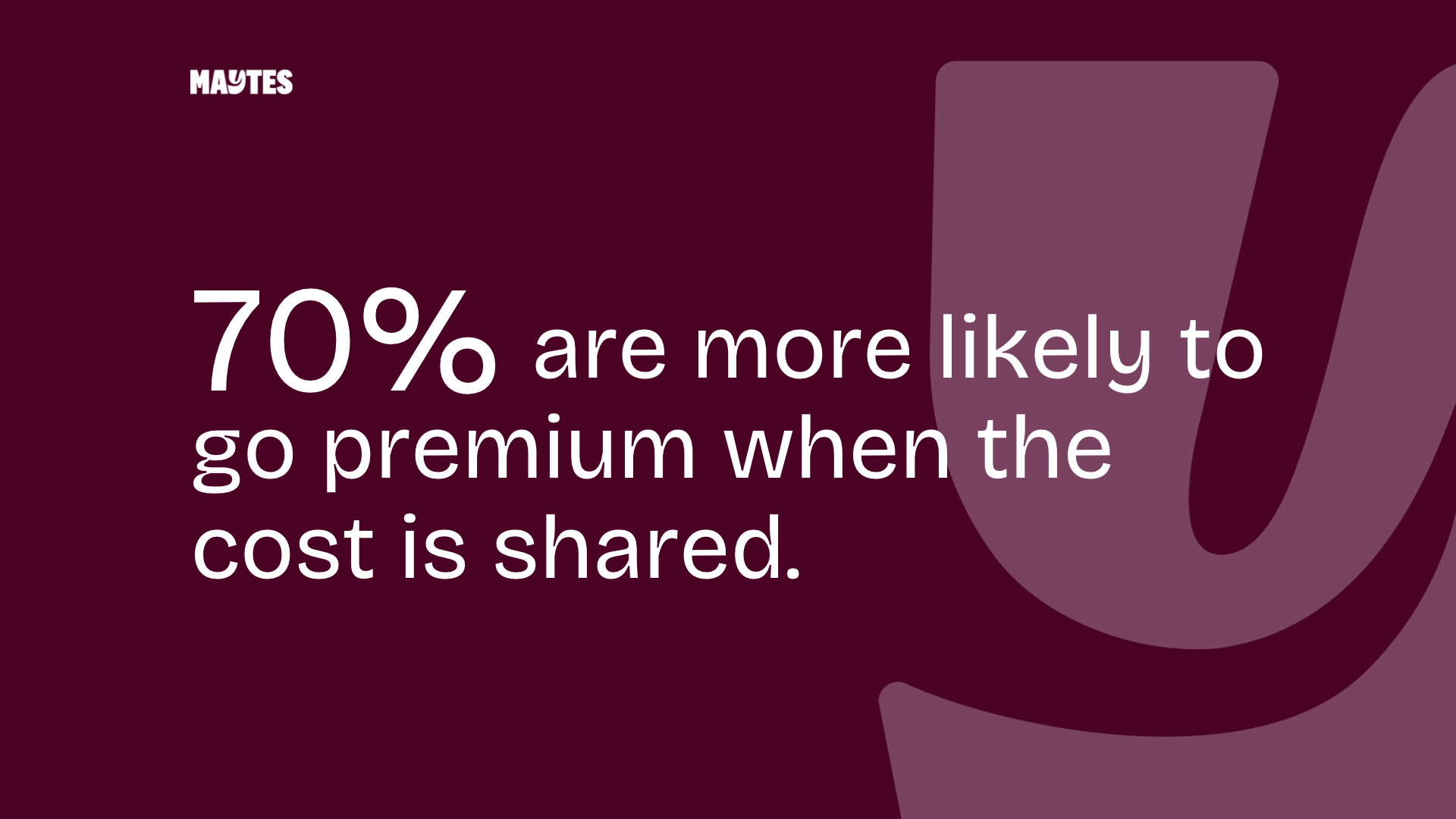
On trade-up: 70% said they would be more likely to choose a premium option. This is the big-ticket finding. The better model, the higher spec, the version everyone actually wanted becomes reachable when the cost is shared rather than fronted, because the constraint was never the group's combined budget. It was one person's card.
Both figures are what organisers say they would do, not measured merchant results. But they point the same direction as common sense: groups that can commit together behave like groups, not like one nervous payer.
Adding group payments is a path decision before it's a product decision: build the capability, repurpose an instalment product, or add a group payment method alongside cards and wallets. We've compared the three ways to add group payments, including when each is right.
For retailers who land on the payment-method path, the selection criteria don't change by vertical, and there's no shortcut list of vendors worth trusting over your own evaluation. What to look for in group payment software for retail is the same set of structural questions any merchant should ask: when the order confirms, who carries the liability and how plainly it's disclosed, whether your settlement is protected from the group, and what the flow asks of the organiser and everyone else. We've set the full criteria and the vendor questions out in how to evaluate group checkout.
Split with Maytes is an alternative payment method at checkout, built so a group can complete one order while each person pays their own share. Through the gift lens: the organiser confirms the present and pays their share, everyone else chips in through a PayLink by SMS or WhatsApp with no app and no account, several reminders and a live view do the chasing, and the recipient never sees any of the machinery. The retailer is paid in full through normal Stripe settlement, typically within two business days, regardless of how the group's payments progress.
Stated plainly, because it should be: the organiser keeps financial responsibility. Group members have a defined payment window, currently 48 hours, and any share unpaid at its close becomes a charge to the organiser. What the design removes is the fronting by default and the collection job, which is the part that makes people stop volunteering.
Get in touch with the Maytes team.
Checkout & Payments
7 min read
Group Payments
7 min read
Checkout & Payments
7 min read