Industry Insights
Why do group stays drop off at checkout, and how can accommodation marketplaces fix it?
Maytes Editorial·May 20, 2026·7 min read
Industry Insights
Group accommodation bookings often fail at checkout because one person is expected to front the full cost of the stay before collecting money from everyone else.
For high-value bookings such as villas, holiday homes, ski chalets, and group accommodation, this creates financial pressure, delays decision-making, and increases abandonment.
Split with Maytes allows the booking to be secured immediately while each traveller pays their share separately, helping accommodation businesses convert more group demand into completed bookings.
If you operate an accommodation marketplace, group stays are often your highest-value bookings. A villa for eight, a ski chalet for six, a large holiday house for a wedding weekend. The intent is there, the basket value is high, and yet the booking still falls apart at checkout because one person is staring at a $4,000 charge on their card.
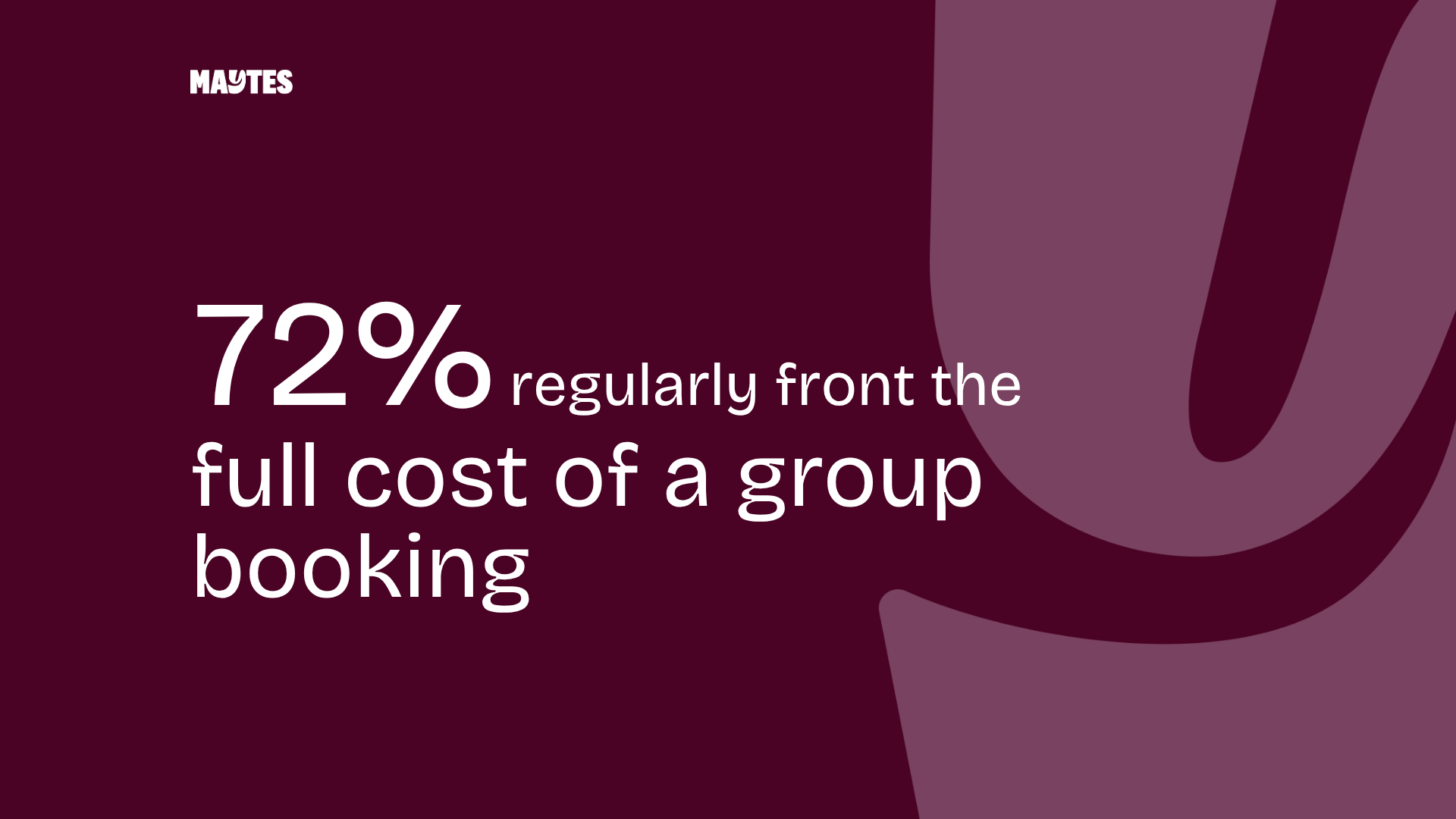
The problem is that a group stay is not really one purchase. It is a coordination problem wearing a checkout. 72% of group buyers regularly front the full cost for the group, taking on the financial responsibility for everyone else while the rest of the group promises to pay them back.
The organiser becomes what participants in our research described as the bank, the spreadsheet, and the help desk, coordinating names, room allocations, repayments, dropouts, and booking logistics all at once.
For accommodation marketplaces, this friction rarely shows up as a group payment problem in the data. It simply appears as a booking that starts, pauses, and eventually disappears.
Most accommodation checkouts were designed for individual purchases. One customer chooses a property, enters their card details, and confirms the booking. Group accommodation works differently, the decision is shared, but the financial responsibility is not.
The organiser ends up fronting the cost, collecting repayments, chasing friends, managing room allocations, and absorbing the risk if someone drops out. A traveller might be comfortable paying $500 for their share of a trip, but they may be much less comfortable putting $4,000 on their card and hoping everyone pays them back. The challenge is not demand. The challenge is coordination.
Split with Maytes allows one person to secure a property at the moment the group agrees to book. Each traveller then pays their share within 48 hours using a secure PayLink, with no app download and no account creation required.
The organiser's bank places a temporary hold on the total booking amount and the property is confirmed immediately. As travellers pay their share, the hold reduces. If someone does not pay within 48 hours, the organiser's held card covers that share and the organiser can recover the cost directly. For the marketplace, the booking appears as a normal confirmed transaction. For the group, the cost has already been divided fairly before check-in.
Three effects typically drive the benefit.
31% of group buyers report missing out because the group took too long to confirm. For accommodation businesses, that often means another group books the property first. Split with Maytes reduces the delay between agreement and booking by allowing the property to be secured at the moment of group intent rather than days later.
73% of buyers told us they would organise larger groups if Split with Maytes existed. For accommodation marketplaces, that can mean larger properties, longer stays, more add-ons, and higher total booking values, without increasing acquisition spend.
When travellers have already paid their share, commitment increases. The booking is not simply being held by one organiser. The entire group has skin in the game. That reduces the likelihood of late dropouts and the cancellation-driven friction that follows.
The pattern is straightforward, the higher the booking value and the larger the group, the greater the opportunity. This includes accommodation marketplaces such as Airbnb, Stayz, Vrbo, and Booking.com, ski chalets and lodges where groups regularly share costs, event accommodation providers covering wedding weekends, sporting tours, and festivals, and large holiday homes and villas designed specifically for group travel.
If a meaningful percentage of your bookings involve four or more guests, organiser friction is likely affecting conversion.
A checkout widget is added alongside existing payment methods. Implementation typically takes less than four weeks, and no major changes to the checkout flow are required. Customers select Split with Maytes, complete the group payment flow, and return to the merchant checkout as they would with any other payment method.
If your platform regularly handles group accommodation, holiday rentals, or high-value shared stays, it may be worth understanding how much demand is being lost when one traveller is expected to carry the full cost.
Get in touch with the Maytes team.